Arduino · Short‑Term Memory · 2023
Sensory Stimulus and
Short‑Term Memory
Measuring how auditory and visual distractions affect short-term memory recall.
Nifemi Lawal, Kyle Maddox, Waseem Mansi, Brian Nohalty & Quinn Heather
University of Kansas Research Symposium · ME 208 · Fall 2023
Abstract
Most people notice their focus slip in a noisy or visually busy room, but the effect is
rarely measured directly. We built a small Arduino-based testing rig to isolate it: subjects
studied an image for twenty seconds, then answered a multiple-choice recall question under
one of three distraction conditions — silence, a short audiovisual clip, or that same
clip layered with continuous background noise. Responses were logged in hardware and scored
in MATLAB across four subjects and forty trials. Recall accuracy fell from 75% with no
distraction to 55% with a single stimulus and 33% under combined audiovisual load, an
inverse relationship that held consistently across subjects.
- 40
- memory trials recorded
- 3
- stimulus conditions
- 4
- student subjects
- 75%
- accuracy, no stimulus
- 33%
- accuracy, dual stimulus
1Research question
How does sensory overload affect a human's short-term memory, and are certain
stimuli more distracting than others?
Working or studying in a distracting environment is a near-universal experience, but the two
halves of that experience are easy to conflate: overload itself, and the specific channel
it arrives through. We split the question accordingly.
- Does adding sensory stimulus — auditory, visual, or both — measurably reduce
short-term recall accuracy?
- Does accuracy decline in proportion to the amount of stimulus, or is the relationship
closer to a threshold effect?
2Methods
Each trial followed the same structure: a subject viewed an image for twenty seconds, the
image was removed, and a multiple-choice question about its content was displayed. The
subject answered by pressing one of four buttons wired to the test rig. Every trial was
tagged with the stimulus condition active while the question was posed, so a single subject's
ten questions could span all three conditions rather than being blocked by level.
Stimulus 0
No distractions. The subject answers in silence, establishing a recall baseline.
Stimulus 1
A short, recognizable audiovisual clip plays before the question is asked.
Stimulus 2
The same clip, plus continuous party noise playing for the entire question.
Testing was conducted with earbuds and a laptop for stimulus playback, alongside the Arduino response rig described below.
3Hardware & data collection
Responses were captured on an Arduino Uno wired to a breadboard circuit rather than a
keyboard or mouse, so subjects couldn't see the answer options laid out in advance and every
trial was timed and logged the same way. Four push buttons map to answer choices A–D; a
piezo speaker and a pair of LEDs give immediate audio and visual feedback on each response.
| Component | Role |
|---|
| 4× push button | Multiple-choice answer input (A–D) |
| Piezo speaker | Ascending tone on a correct answer, low tone on incorrect |
| Green / red LED | Visual correct / incorrect feedback per trial |
| Arduino Uno | Reads button state, advances the question loop, logs results over serial |
The sketch runs as a simple state machine: one function checks the current question's button
input against the preset correct answer, advances to the next question, and fires the
matching tone/LED feedback. A running tally and a per-question correct/incorrect array are
printed to serial once all four questions are answered.
Arduino C++ · digital I/O · tone() feedback · serial logging
4Analysis
Each subject's ten logged trials come back as a correct/incorrect array alongside the
stimulus level active for that question. A MATLAB script parses the logs, groups correct
answers by stimulus level (0, 1, or 2) across all subjects, and computes the mean and spread
of correct responses at each level.
The result is plotted as a bar chart of mean correct answers per stimulus level with error
bars showing the spread across subjects — the same figure reproduced in the findings
below, expressed here as accuracy rather than raw counts.
MATLAB · grouped aggregation · bar chart with error bars
5Findings
Accuracy fell as stimulus intensity rose
Across all four subjects, recall accuracy declined as distraction increased: 75% correct with
no stimulus, 55% with a single audiovisual clip, and 33% once continuous background noise was
layered on top. The drop is close to linear across the three conditions, and the direction
was consistent for every subject tested — no one improved under added stimulus.
Stimulus 0
No distraction
Stimulus 1
Audiovisual clip
Stimulus 2
Clip + party noise
Figure. Mean recall accuracy by stimulus condition, aggregated across four subjects and forty trials.
Combined stimuli hurt more than either alone
The steepest drop comes between stimulus 1 and stimulus 2 — adding continuous background
noise on top of an already-playing clip costs more accuracy than the clip alone. That points
to auditory and visual load compounding rather than simply adding a fixed penalty each time a
distraction is introduced.
Limitations
- Four subjects is a small sample; individual variation in attention is not separated from the stimulus effect.
- Stimulus order was not fully randomized per subject, which could introduce fatigue or practice effects.
- Only one stimulus pairing (audiovisual clip + noise) was tested, not isolated auditory-only or visual-only conditions.
Future work
- Test auditory-only and visual-only distraction separately to isolate which channel drives the effect.
- Repeat the protocol on a task requiring active auditory focus, to see whether the same ranking holds.
- Expand the subject pool and randomize condition order to control for fatigue.
6Research poster
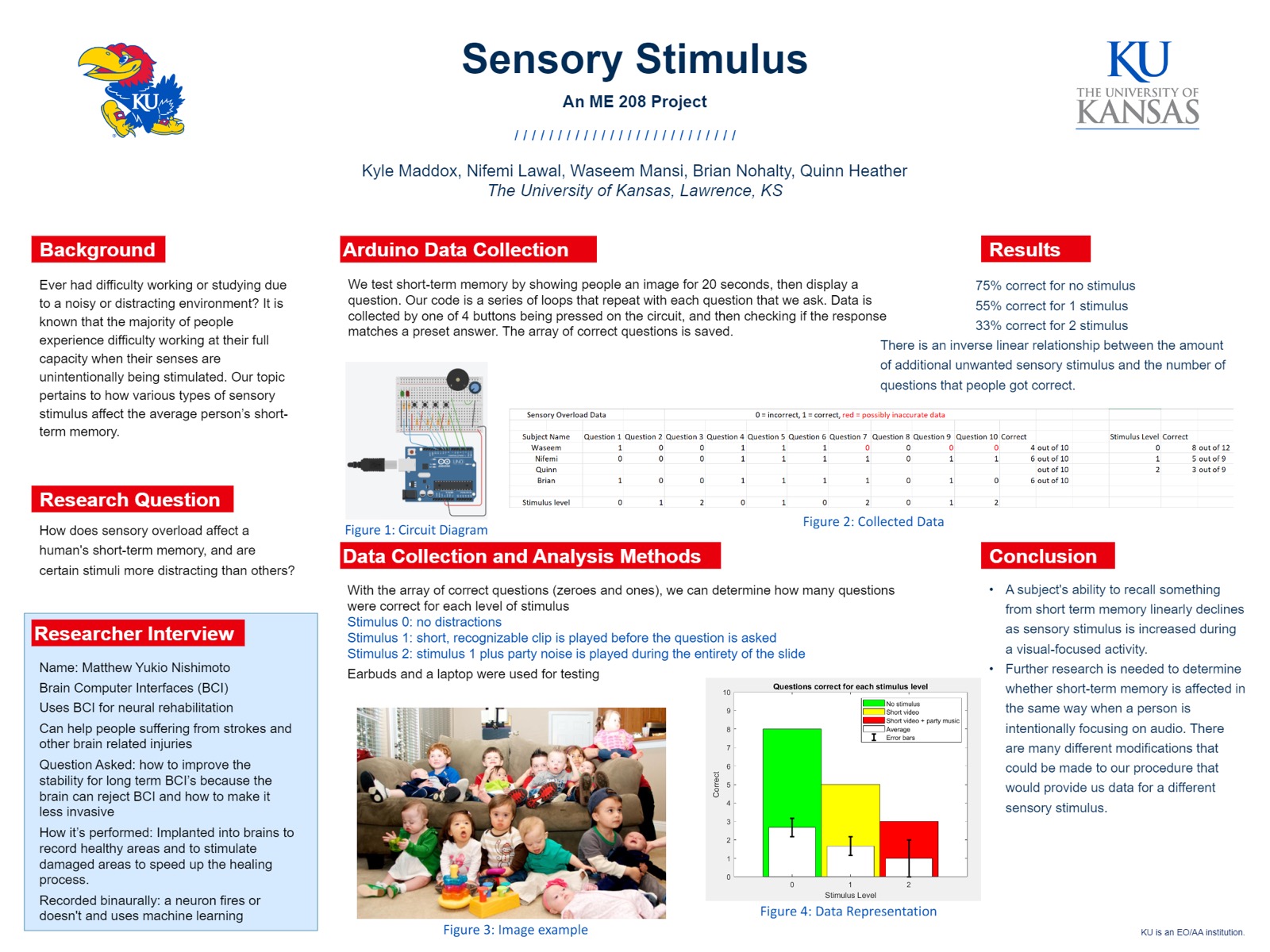
Presented at the University of Kansas Research Symposium, the poster below covers the full
study — background, research question, circuit diagram, collected data, and conclusions.
Scroll or pinch to zoom on mobile. Open the full-resolution poster to read the data tables in detail.
Open full poster →